
How “Why Not Me?” Can Change the Way We Face Life’s Hardships
We’ve all been there. The phone rings with bad news. The doctor’s voice drops an octave. The layoff email hits your inbox. The relationship you thought was solid quietly unravels. And in that split second, before logic kicks in, before you even know how to breathe through it, the same question echoes in your head: Why me?
The Trap of “Why Me?” (and How It Keeps Us Stuck)
It’s a completely human reflex. But here’s the uncomfortable truth: that very question is often the thing that keeps us trapped. It paints us as victims of circumstance. It implies that hardship is a personal attack, a cosmic mistake, something that shouldn’t be happening to us. And while that feeling is valid, it’s also heavy. It drains the energy we actually need to navigate what’s in front of us.
Flipping the Script: From Victimhood to Ownership
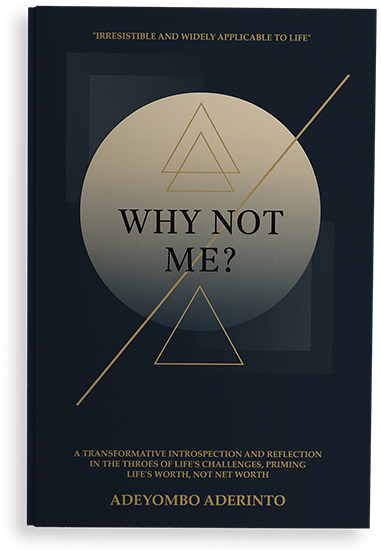
In Adeyombo Aderinto’s deeply personal, quietly powerful book Why Not Me?, he doesn’t just describe that moment; he walks right through it and hands us a completely different question. One that doesn’t erase the pain, but changes what the pain does to us.
Aderinto didn’t set out to write a self-help book. He set out to survive. When a routine blood test spiraled into a cancer diagnosis, his carefully mapped life stopped spinning on its usual axis. He describes sitting in a sterile office, hearing those two heavy syllables, and feeling the floor drop out. It’s a moment so many of us dread. But instead of letting it break him, he let it wake him up. And that’s where the real shift begins.
It’s Not Toxic Positivity, It’s a Survival Tool
“Why not me?” isn’t about pretending that hardship is easy, fair, or deserved. It’s about ownership. It’s about looking at the curveball life just threw and saying, Okay. This is mine now. What do I do with it? Aderinto writes about this pivot not as a philosophical exercise, but as a survival tool. When you stop asking why the universe singled you out, you finally free up the mental space to actually respond. You stop resisting what’s happening and start working with it.
What makes this book so grounded is that it doesn’t stay in the abstract. It’s packed with real, breathing moments that show this mindset in action.
The Wooden Cross, The Phone Battery, The Legacy of Love
Take Andrea, a ten-year-old student with autism who quietly handed him a small wooden cross “for your protection.” She didn’t do it for praise. She didn’t even stick around for a thank-you. It was just pure, unfiltered care. Then there’s the stranger at a chaotic border crossing who handed him his own phone battery when Aderinto’s died, refusing payment, simply saying, “You need to get home safely.” And Jinmi, who named his newborn son after a childhood friend who passed away at eight years old, turned decades of grief into a living legacy of love.
These aren’t just sweet anecdotes. They’re proof that when life strips away the noise, what’s left is radically human. And that’s the exact space where “Why not me?” thrives. It’s not about having all the answers. It’s about staying open to the people, the moments, and the quiet graces that show up right when you think you’re running on empty.
Trading Net Worth for Life’s Worth
One of the quietest revolutions in the book is how it redefines success. We’ve been culturally trained to measure our lives in net worth, titles, bank accounts, productivity metrics, and social proof. But hardship doesn’t care about your LinkedIn profile. When you’re sitting in a hospital bed, waiting for test results, or watching someone you love navigate their own storm, the only metric that actually matters is life’s worth.
Aderinto puts it beautifully: life’s worth is built on gratitude, on showing up for people, on sitting with discomfort instead of running from it, on choosing connection over convenience. It’s not flashy. But it’s the only thing that actually lasts.
How to Actually Practice This Shift
So, how do you actually bring this into your own life? You don’t need a life-altering diagnosis to start. You just need a willingness to reframe. Next time something goes sideways, maybe it’s a missed promotion, a fractured friendship, a health scare, or just that heavy, lingering sense that you’re falling behind, pause. Notice the “Why me?” creeping in. Then gently swap it out. Ask yourself: Why not me?
Not as a resignation, but as an invitation. What is this trying to teach me? Who do I get to become because of it? What small act of grace can I offer myself or someone else today?
Aderinto’s journey shows us that growth isn’t about avoiding the storm. It’s about learning how to stand in the rain without pretending you’re not getting wet. It’s about letting the experience sand down your edges instead of sharpening your resentment.
The Illusion of Infinite Time
There’s another layer here that hits hard: time. Before his diagnosis, Aderinto admits he treated time like it was infinite. He put things off, minimized his potential, waited for the “right moment.” Hardship shatters that illusion. It doesn’t just remind you that time is short; it demands that you treat it like it’s precious.
Not in a frantic, hustle-culture way, but in a deliberate, grounded way. It means saying hello to people like you actually means it. It means finishing the project you’ve been shelving. It means calling your mom. It means giving yourself permission to be a work in progress, right now, exactly where you are.
Why This Book Stays with You
Why Not Me? isn’t a book that promises you’ll never face hardship again. Life doesn’t work that way. What it does offer is a different way to meet it. It’s a quiet, steady companion for anyone who’s tired of asking why life is so hard and is finally ready to ask how it’s shaping them.
Because here’s the truth Aderinto lives out on every page: the challenges don’t diminish your worth. They reveal it. And when you stop fighting the reality of your circumstances and start leaning into them with curiosity, courage, and a whole lot of grace, something remarkable happens. You stop surviving your life. You start living it. So, the next time life hands you something heavy, take a breath. Look at it. And instead of asking why it had to be you, try asking: Why not me? You might just surprise yourself with how much lighter the load feels when you carry it with intention.